

501.5K
Downloads
1007
Episodes
Running injury tips on self-diagnosis and self-treatment. Simple strategies for rapid recovery of running injuries.
Episodes

Wednesday Jan 31, 2018
Wednesday Jan 31, 2018
This week I got a couple of calls from runners who had various different forms of foot pain and they both said the doctor they saw said they had a condition called synovitis. They were both understandably confused because neither one of them really understood what “synovitis” really means.
Synovial tissue is the tissue that makes the fluid that lubricates your joints. The fluid on the inside of your joints is called “synovial fluid.”
This is the stuff that lubricates and nourishes the cartilage on the inside of your knee joint, your ankle joint and all the other joints in your body. This fluid not only helps to lubricate the joint it also nourishes and keeps the cartilage healthy.
On the inside of the joint you have this soft squishy tissue, called synovial tissue, that makes that lubricating fluid. Sometimes you may hear it called synovium. Synovium and synovial tissue are synonymous. They’re both the same thing but they are different terms your doctor may use interchangeably to further confuse you.
Today on the Doc On The Run Podcast we’re talking about synovitis in runners.
Wednesday Jan 24, 2018
Wednesday Jan 24, 2018
Wednesday Jan 17, 2018
Wednesday Jan 17, 2018
Sleep may be the most valuable, most abundant, least expensive, and yet most underutilized resource available to a recovering or injured runner.
If you are a runner, you are always recovering. You do tissue damage every time you run. If you run a little too much, or you run a little too far, you might get an over training injury. That overtraining injury is really nothing more than an exaggerated version of the intentional injury you are attempting induce when you are training.
Sleep Helps You Heal, Running Doesn’t Help You Heal.
Sleep is crucial for proper immune function, tissue healing and consequently healing after any hard workout or running injury. Sleep disturbances reportedly occur in one third of the U.S. population. Problems with sleep are so pervasive and detrimental that the Centers for Disease Control has declared insufficient sleep as a public health problem.
Interestingly, elite athletes have actually been cited as a group having poor sleep quality and reduced quantity of sleep in comparison to the general population. Why is that?
Today on the Doc On the Run Podcast we’re talking about how sleep is the recovering runner’s secret weapon.
Wednesday Jan 10, 2018
Wednesday Jan 10, 2018
The problem with running injuries is that they are easy to ignore. A little tightness here or little achiness there is nothing compared to the pain you feel in those final few miles of a marathon. Runners are used to ignoring pain. One of the most important elements of training for endurance sports is learning how to endure. After all, enduring is the name of the game. You have to learn how to keep running when your quads tell you to quit. You learn to ignore the burn, tune out the noise and keep going. You have to learn how to suffer.
It is just not surprising that runners ignore the early sensations they can signify the start of a running injury. What we have here, is failure to communicate. Your running injury didn’t start the day you called a doctor for help. Your running injury started weeks or months before you told anybody about it.
But I would be willing to bet that you knew it was there. Deep down inside, you knew something was wrong. Maybe you didn’t want to see it. Maybe you didn’t want to feel it. Maybe you didn’t want to acknowledge it. But I’ll bet you had some subtle clue trouble was brewing.
Today on the Doc On The Run podcast we’re talking about how communication can help prevent running injuries and help running injuries heal faster.
Wednesday Jan 03, 2018
Wednesday Jan 03, 2018
A goal is not a fantasy. A goal is not a dream. It’s a place you clearly want to end up. If that goal is important to you, I believe you can get there. No matter how far-fetched, outlandish, or seemingly difficult to achieve, there is always a way to get there.They set all kinds of goals for themselves, their families, their finances, and of course, their athletic goals as well.
For most people the process of goal setting includes some analysis of the past. Maybe your just look at how fast you have run historically. Maybe you look at how much money you made last year. Maybe you look at how much time you spent with your family. In all likelihood your goals are partly based upon your past performance.
Part of the reason we base or future upon our past achievements is that we want to make sure that our goals are achievable. After all, no one enjoys failure.
Today on the Doc On the Run Podcast we’re talking about how injured runners should focus on the goal.
Wednesday Dec 27, 2017
Wednesday Dec 27, 2017
Over and over patients tell me their doctor has told them to quit running. The doctor has said that running is at the root cause of the running injury. B.S.!
Breathing doesn't cause lung disease. Eating doesn't cause stomach upset or heart disease. Driving doesn't cause automobile accidents. Spending money doesn't cause bankruptcy.
Running doesn't cause running injuries. Running isn't the problem. It's the choices we make when we are running (and recovering) that leads to a problem.
If you're a runner it's important you understand first and foremost that running does not cause running injuries. And if you happen to get injured and you seek treatment for your running injury it's important you understand how to talk to your physician and convince your physician that running is not the problem.
Wednesday Dec 20, 2017
Wednesday Dec 20, 2017
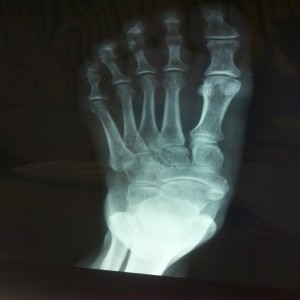
Rodney asked about a non-displaced fifth metatarsal fracture. He said “Hi, it’s been 8 weeks and my orthopedic doctor says it’s healed. Even though the x-ray doesn’t look like it’s healed. There is still a black in the gap where it was broken. He says that line will be there. Is this possible?”
Metatarsal fractures are extremely common. In fact metatarsal bones are fractured more often than any other bones in the foot among runners. Because these little bones happen to be the longest bones in your foot they’re also crucially important to the stability and structure of your foot. So you have to make sure they heal before you can get back to running with confidence.
X-rays are the most frequently used diagnostic tool to evaluate the positioning and state of healing of fractured metatarsal bones. But there’s a lot of variability in the appearance of a fractured bone when you’re looking at it on an x-ray.
In this week's podcast were talking about how x-rays show metatarsal fracture healing.

Wednesday Dec 13, 2017
Wednesday Dec 13, 2017

Wednesday Dec 06, 2017
Wednesday Dec 06, 2017
Today on the Doc On The Run Podcast I’m really excited to have Marla on the show to talk about her experience with recovering from a running injury.
Running injuries can be really difficult for lots of reasons and one of the reasons I think they seem to be so difficult is that the standard of approach in medicine is to first tell you to “stop running”. Sometimes the standard medical approach, or the “standard of care” as we like to call it, can send you spiraling down this path of frustration and despair and it becomes more and more difficult to actually get yourself out of that spiral.
But Marla has a really great perspective on everything involved and trying to navigate the whole medical system and actually recover, not just using the standard approach which is usually offered to us when we get injured, but really trying to step back and look at all these different components of recovery from an injury and then try to really change what she was doing, assess what she was doing and make changes as she went throughout the course of recovery to try to really get the best improvement as quickly as possible.

Tuesday Nov 28, 2017
Tuesday Nov 28, 2017
Today on the Doc On The Run podcast we are going to discuss how Paternalism fails runners.
During a sermon one Sunday morning in 1896 in Dayton, Ohio, Bishop Milton Wright said, “If man was meant to fly, God would have given him wings!”
Lucky for us, his sons didn't listen. Had Wilbur and Orville actually taken their father’s admonitions to heart, it would certainly take us a lot longer to get from San Francisco to New York.
As a father myself I cannot believe the good bishop was hoping to crush his children's dreams. I can only assume he wanted to protect his boys. He wanted to protect them from what, to him, seemed to be a foolish idea of propelling themselves through the sky. He didn't want them to die in the process of seeking an adventure.
In retrospect, it is clear Bishop Wright had the wrong idea. His kids wanted to fly. And so they did. The doctor wants to protect runners from further injury. It's part of the Hippocratic Oath: “First, do no harm.” It's part of what they have sworn to do. But doctors should also encourage you to fly. They should look for new ways to get you from point A to point B. They shouldn't look at the old methods of healing and recovery and think it's enough for an injured runner.
Nobody wants to ride a donkey from San Francisco to New York. It's the doctor's job to help you look to the sky. It's the doctor's job to help you fly.